Search This Blog

Saturday, April 5, 2014

Project Based Learning Day in Siberia

If I ever had any doubts about the merits of project-based learning, they were put to rest today at the Ethnographic museum in Vlasikha village which is about a 40 minute drive outside of Barnaul. 

Marina, the director of the English school at which we are teaching,  drove us past the birch tree filled forest. Her adorable daughter, Masha, joined us. Masha sat in the front seat. At eight years old, she's already reading picture books in English: we could be teaching children foreign languages this early. 


At the museum, we not only learned about Siberian crafts, but also participated in the making of them. The babushka below taught is how to weave bracelets and belts with our fingers using our pinkies as hooks. I wasn't sure that I would be able to figure out the finger work. 

And she seemed a little scary at first. 


But she worked with me and was patient.
 

I managed to figure it out after some practice and remembered how much I used to like latch hook, knitting and other crafts as a kid. I thought of my nieces and students who use rainbow looms. 
Soon I had the hang if it and found it relaxing. 


Finger looming is good travel therapy and I liked it. 


Next we moved on to pottery. Tracey fearlessly stepped up the the wheel and remembered all that she had learned from an early ceramics class. 


Masha clearly loved it. E, J, N, R, G and eventually S: this is a perfect aunt activity. 


Next we moved on to the craft of making little dolls. These are constructed from scraps of fabric. 


The dolls were used to ward off the evil eye, to help babies sleep or even to promote milk in nursing mothers. 

I do not think that I have a future in this type of work.


Next, we moved on to making a spring cookie in the shape of a bird. If I understood correctly, there is no butter or egg in this. They use pickle juice in the recipe (does the fermented juice provide the "lift"?) The cookies tasted like hard challah bread and we ate them with homemade jam and Altai honey. 

  
Masha was proud of her work. 


We watched a performance by the village children. If you'd like to see footage of this, please see my Facebook page. Students, please see yours. 

Parents send their children to the village school to learn the traditional songs. Some children were tiny and adorable. 


Others (equally charming) appeared closer to my students' age. 

Nearly all seemed quite happy with their fancy footwork and singing. 


The museum treated us to a traditional post (lent) lunch complete with pickled tomatoes, foraged mushrooms and cabbage salad. 

I tried everything. Meat and dairy is not permitted during Eastern Orthodox lent. 


My family, students and friends know that was worried about eating only potatoes and scallions for two weeks but this was the first time these appeared on the menu. 


Tatyana (our host teacher) has worked tirelessly to provide us with a once in a lifetime experience. 

This is the real Russia and I never would have seen it if I ventured only to St. Petersburg or Moscow. 


I certainly never could have met Masha who is hiding here in the model house in the warm sleeping nook above the oven.  

Students: what adventure travel awaits you?


Friday, April 4, 2014

Siberian teachers, students and hotels.

So much to learn here in Siberia.  

For adults, Facebook is not used as much as in the US.   Here they use the equivalent of classmates.com.  Our generous and super organized host teacher, Tatyana, let me take this picture of her page:


I was particularly impressed with this photo of the fruits and vegetables produced on her family dacha.  


Many families have dachas or country/village escapes where they go to escape the city and to grow food for their families. We will visit a similar home tomorrow. 

The picture below is of one of the students in my English foreign language class who spoke passionately of her adoration of Harry Potter.  The video footage of this is on my Facebook page for my  friends and students.


I found the students shy at first and then really interested and curious about the United States. Not one of them had heard of Los Angeles or Beverly Hills.  They also hadn't heard of California. But they knew Hollywood so that's the city with which I went. 

Later, Tracey and I met with teachers from the language institute.  We used methods that we would use in our own classes to explain the school system.  We had them do a What do You Know/ What do You Want to Know activity at the beginning. We had them pair share and then share out their favorite questions with the group.  In order to answer their questions Tracey showed footage from her school district and I used the Prezi that my Sophomore Honors students produced. Students: our Prezi was a huge success. I loved being able to tell them that you created it. 

The teachers had never heard of Prezi and were excited to give it a try.


Tracey and I come from very different school districts. She is from Atlanta and I am from Beverly Hills. We have different opportunities and challenges. It's good to learn from another teacher of this caliber.  This is just another reason why the TCG program is so strong.  Everything about it is a best practice in action.


These are some of the teachers to whom we spoke. Notice Alexander on the right.  Americans might wrap their arms around each other: not so here. Alexander seems to stand apart from the group. He is a lovely Spanish teacher and I enjoyed practicing my Spanish with him. 

By the way, the Spanish teachers here speak the language as if from Spain:  not South or Central America. 


Tatyana arranged for us to the Siberian Chamber Orchestra last night. The Orcastra is quite famous and travels the world.  I will add some pictures of this later. I was surprised by how much I enjoyed it.

I don't want to keep you in suspense any longer about my Siberian abode. Please see pictures of my room at the Tsentralnaya Hotel.  Notice that the sink and the shower use the same outlet.


I'm  getting the full Siberian experience in this regional hotel.

Thursday, April 3, 2014

Barnaul, Siberia. Our home for the next week.

We left Moscow to go to the airport five hours before our flight. This is because the traffic is horrible in Moscow. Apparently Muscovites  cannot guarantee whether it will take one or three hours to arrive to a destination. 
 
Security was a breeze by comparison to the states: I don't think this is necessarily a good thing. 

Once we arrived in the waiting area I started looking for potential photos. 

Like this one below: can you tell what this girl is reading? I'm sure my students can.


I don't even know what to make of this doll.


Finally we boarded. Aeroflot is a whole new experience:  think Southwest in Russia with even more chaos.


We were picked up by some of our host teachers whom you will see in later blog posts and toured the city.  

I love this monument of a mother saying goodbye to her son before he goes off to war.


But  what I enjoy most is seeing how people live.  We asked to go to a grocery store and  stumbled upon Barnaul's answer to Whole Foods.

Homemade juices:


And who doesn't love a good salad?

I felt very at home here.


Gardening is  huge  in this area. Nearly everyone gardens. Seed packets can be found outside stores. 


There were aisles and aisles of seeds dedicated  to Siberian varieties. Tomatoes don't go out until late in the season. I think I understood that they don't expect to harvest until August or September. Gardening is not just a fun activity. In this area people really need to garden in order to feed their families.


The local museum housed artifacts from the Soviet era.

Pioneer uniforms:


Factory worker suits:


Finally we took a quick visit to the lake where the ice is melting. According to our hosts one can walk across the entire lake during the depths of winter. People ice fish and skate.


We begin teaching tomorrow.

Wednesday, April 2, 2014

Technology School 1637: Reading, Writing and Robotics.

IREX and the State Department are doing their best to expose us to a variety of types of schools. Yesterday we visited Technology School 1637. These students are getting an impressive education and we can learn a lot from them.

Some things are very different like the snow on the playground,


and the man with the orange jacket shoveling snow on the roof of a building. Who knew?

Once we entered the room we noticed the requisite whole rooms for coats. This precious real estate is in every establishment in Russia. This includes schools. Notice the snowboots on the floor; teachers and students wear boots to school and change once they arrive.


This school followed the Russian tradition of offering us bread with salt when we entered the building.  


The Russians seem to adore their president.  Mr. Putin has an over 80% approval rating in this country. The picture below hung proudly over the principal's desk.


We visited many English classes where we saw different methods of teaching at work. In the class depicted below, we saw kids, the same age as my sophomores, engaged in a debate about extreme sports. The students debated the merits of extreme sports and we visitors were able to assist them in their debate. 
The teacher below ask them to choose names for their teams.  One side of the room shows the Luxury Girls. The other side shows the Sochi Olympic Winners. 

I must emphasize how much Russians are proud of their showing at Sochi.


Students here are extremely courteous and seem to adore  their teachers.


Below you will see an example of the practice for state testing. The way that the teachers instruct prepares the students for the test. Testing is accomplished on computers.
In nearly every class that I've visited, teachers are nervously preparing students for state testing. Sound familiar?
   
For my English teacher comrades, there is no process writing at all. Students write essays, hand them in, and get a grade.  Boom. 
Done. 
I am told that Russian teachers and students are shocked by the idea that we give students several attempts to develop their papers.
Students here would love their teachers to adopt the same practice of allowing for revision. 

Robotics is a crown jewel  of Technology School 1637 and I loved what we saw. I wish my robotics students could have been with me for the demonstration. 
If you'd like to see videos of what these contraptions do please see my Facebook page (or for my students, see your group page).  


On another note, wood shop is alive and well in Moscow! Notice the home made matryoshka dolll on the shelf. 
 Seeing the class made me think of the outstanding work that our technical arts teachers are doing. I especially thought of Melony Bronder's architecture and ceramics classes.

In this school there are several institutions housed together. This practice of grouping schools saves districts money.  I think we've been talking about this in my district since the 90s. Students start from kindergarten and go all the way through the 11th grade, the end of their secondary education, to the same complex of schools.

Here are some dancers from the middle school:

The smaller children are particularly adorable. While there is no uniform, the parents for each grade level determines the color of the clothing that their kids will wear to school. Notice the neck dressings and bows for the girls. Whilw they are dressed similarly, it's clear that the parents take pride in dressing up their little girls.


These kids are  crazy adorable. Many treated us like celebrities and wanted our pictures. They love smiling and practicing their English. "Hello. How are you? Where are you from?" they chirp in beautifully accented English. 


By the way, students study English and other foreign languages  by the first grade. The teachers and students with whom I spoke think that it's really strange that we start so late.  One student asked, "how can you learn a foreign language if you don't start early?" She's already fluent in five languages.

Imagine:this little girl below will speak at least four languages by the time she is 18. We could do this for our students too.


We were treated to a full school performance at the end of the day complete with ballet, Russian dance, Russian folk  and other  patriotic songs.

Check out the Russian flag antennae:


 Much of the emphasis of these performances stressed how much Russia wants to be our (America's) friend. 

These extremely talented dancers rushed us after the show and begged to take a picture with us.


It was a full and meaningful day but I'm ready to journey to Siberia. I want to see how the regions differ from the big city. 


Tuesday, April 1, 2014

Our First Russian School-- SAAS

So much learned today in only a 12 hour period! 

We met with Victor Kruglayakov today while at the Slavic Anglo American School (SAAS). He'serves on the Moscow Duma (city council) and is Chair of the Commission on Education and Youth Policy.  I'm sure you can tell who he is in the picture.

 Some fun Russian facts about education include the reality that the city of Moscow spends 14% of its entire budget on education. They get no federal funds at all. Moscow spends more money on education then any other city in the country.  There are 4500 schools in Moscow with kids from first through eleventh grades. 280,000 teachers work in education.  I can't even imagine this number.  Parents can send their children to nursery schools for free as early as two months old. These preschools are almost all free. Most Moscow children attend preschool for full days and get up to 3 to 4 meals a day. 

BHHS PTA mom friends:  here in Moscow you'd make many of the important decisions along with the teachers.  You would able to accept or reject administrative candidates sent by the Department of Education.  Ultimately you and teachers would make those decisions.  

There was no mention of a Board of Education.

There are different criteria for teacher pay. It used to be pay for years of service but now Moscow schools pay as a result of student performance.

During the communist era, Special Needs children had no place to go. They were kept at home. There were no ramps or elevators. A few years ago these children were labeled "invalids". They are now called children "with limited opportunities".  I guess it's an improvement.  


In the picture below you will see smiling sophomores standing at  attention when we adults entered the room. We marveled each time we walked into a room and the students immediately rose to their feet.
This school has no more than 25 kids in a class but we saw very few classes with more than 12.  


Teacher friends, does the photo below look familiar?  I wanted to know if the instructor knew. . . 
By the way, Russian kids love their iphones every bit as much as our students.  The teachers spoke about Iphone use being a challenge.
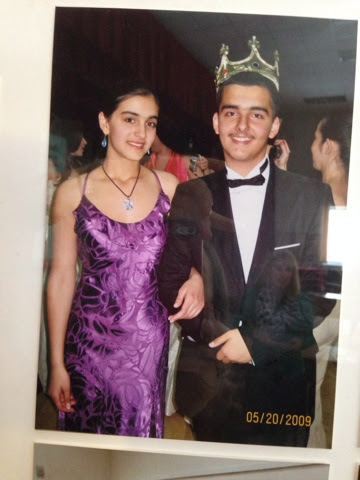
Prom  is celebrated in this city. Notice the proud prom king. From what we saw prom takes place during the day.

These kids appear to take this event very seriously :-)  Just like our own Normans.
I loved the ritual of the below dance.

The library was compact and orderly: the most well lit room in the school.
Of course Charlotte's Web is beloved around the world: I was struck by the photocopy of the book. I don't think that would fly at BHHS.
And while we're talking about books. . . . .
By 2015 every Russian textbook publishing house must have an online version of their books. We saw an extraordinary demonstration of one of these interactive textbooks.

 I want online textbooks for our kids. 

My favorite fact of the day was that 95% of all administrators teach classes. The principal who proudly toured us through her school today teaches physics and still loves it. Russians strongly believe  that when principlals teach, they have a better connection to their students.  Let me throw my two cents in: I believe that administrators  would also have a much stronger connection to their teachers if they taught.  Everyone would win in this scenario.

The fierce physics teaching principal at SAAS :


Another full day of touring schools tomorrow and then a night flight to Barnaul, Siberia.  We split up with our cohort from the states at this point and journey to six different locations around the country.  We will not see our friends for a week when we return to Moscow to debrief.  

'Twas a day well spent.